How To Write Your P.Eng. Competency Assessments
So you've identified an experience from your work history for one of APEGA's 22 competencies needed to apply for your P.Eng. Now what? It's about more than just what you did, you also need to tell a compelling story of how you applied the engineering practice.

How To Write Your P.Eng. Competency Assessments
So you've identified an experience from your work history for one of APEGA's 22 competencies needed to apply for your P.Eng. Now what?
It's about more than just what you did, you also need to tell a compelling story of how you applied the engineering practice. To tell a story you need a beginning, middle, and an end. It's the same for each competency. You will need to describe the situation at hand, the action you took, and the outcome actions and the situation.
What is Situation, Action, Outcome (SAO)?
SAO is the way APEGA requires you to structure your application forms. Breaking each competency into sections allows you to demonstrate your experience in a clear and persuasive manner.
1. Situation: Explain the overview of the situation. What was the problem or project? Set the scene for the Action section.
2. Action: What did you do to address the situation? Include methods used and steps taken while focusing on specific skills and knowledge you applied.
3. Outcome: Describe the short-term and long-term implications that your actions had on the situation. This could be a solution, product, process, or any other outcome.
Carousel Slides (SAO Framework Visuals)
- •Slide 1: Situation, Action, Outcome
- •Slide 2: Situation - Describe the situation or problem you are using for the competency
- •Slide 3: Example: I was tasked with improving a control system for a motor, but my prototype circuit design was not functioning as intended
- •Slide 4: Action - the steps or knowledge used to solve the problem
- •Slide 5: Example: I conducted research on components, consulted mentors, and used simulation software which helped me to troubleshoot issues and identify design flaws
- •Slide 6: Outcome - the result of your actions such as a solution, product, or process. Example: after several iterations, I was able to identify all issues and deliver a functioning circuit
Make your Competencies Stand Out
Using the SAO framework when structuring your writing about your competencies will help you in creating a stong P.Eng. application. But it isn't the only thing you need to keep in mind when writing:
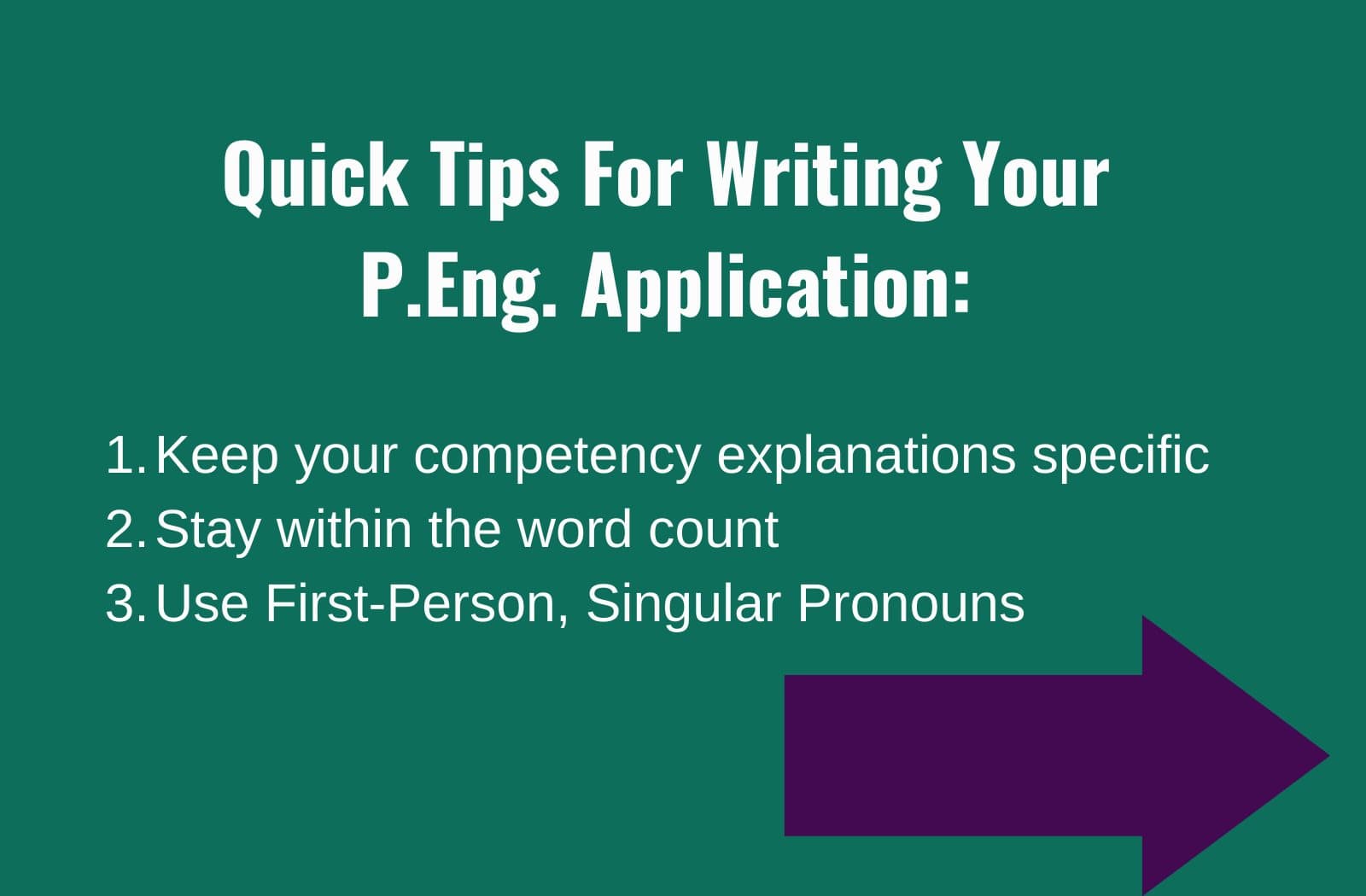
Keep your competency explanations specific
It's easy to get wrapped up in explaining situations, but keep the details to a minimum and make sure your impact is what stands out the most. Skip the budget and location, APEGA wants to know about the work.
Stay within the word count
APEGA has a character limit on each competency entry - something we wish we had known when writing our applications. This max lengths means you're probably over estimating how much you need to write. You only have 400 characters for Situation, 1800 for Action, and 400 for outcomes. Use your words wisely
Use First-Person, Singular Pronouns
In case you forgot from English class, here's a quick refresher:
- •First singular: I, me
- •First plural: we, us
We know that you will rarely be working alone on a project, but your P.Eng. application is the place to focus on yourself, and what YOU contributed. Get a little braggy, this is the place to do it! Limit your use of plural pronouns and tell YOUR story.
There's a lot to think about when putting together your P.Eng. application, and we want to help.
Check out how we can support you with your P.Eng. application
Related Articles
Aligning Engineering Experience with P. Eng. Competencies: A Guide to Bridging the Gap
As engineers, we often find ourselves at the crossroads of technical expertise and professional development. This blog will give some examples of how to think about your work experiences in a way that aligns with the P.Eng. competencies.
What happens if your P.Eng. application is deferred?
So you've submitted your P.Eng. application and you've gotten a bad surprise; you've received a notice of deferral. Not what you were hoping for, but no need to panic. Keep reading to learn more about moving forward after a P.Eng. application deferral.
When To Start Writing Your P.Eng. Application
After 4 (or more) years in school, you're probably enjoying being out in the workforce as an Engineer in training. You're starting to think ahead to your P. Eng., but it still seems like a long time away. But you want to start compiling your experience for your application as soon as possible.